

Australian Institute of International Affairs South Australia
Powered by
Events
Upcoming
Past events
Jun
22
2022
Past Event
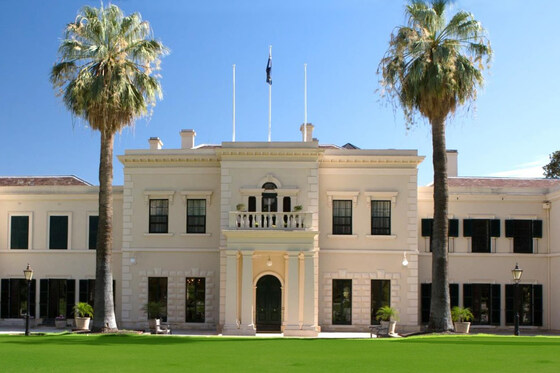
Reception hosted by Her Excellency the Governor for the Australian Institute for International Affairs, South Australia
Government House
17:00 – 18:00
On Wednesday, 22 June, Her Excellency the Honourable Frances Adamson AC, Governor of South Australia, and Mr Rod Bunten will host a reception at Government House for members and friends of the AIIA in South Australia. This will be an opportunity to celebrate the recent establishment of an AIIA branch in South Australia, as well as raise awareness in the South Australian community of our objectives as an organization, including promoting public understanding of international affairs, and fostering an erudite conversation on the key international issues of the day.
The event will be attended by the AIIA SA branch executive, as well as the National AIIA President Allan Gyngell AO, and National AIIA Executive Director Dr Bryce Wakefield.

May
24
2022
Past Event
Not your Parents' European Community - The Economic Integration of Europe - Prof Richard Pomfret
Napier Building The University of Adelaide
17:30 – 19:30
The EU is Australia's second largest trading partner and second largest source of foreign investment. However, for reasons discussed in this presentation by Emeritus Professor Richard Pomfret Australian governments, media and much of the population typically do not have an accurate understanding of the EU as an institution with a long-established common trade policy; one that is continuing to evolve towards ever deeper economic and political integration.
Australians still tend to view the EU through the agricultural policies of the 1970s and 1980s and British misunderstandings of the European integration project. As a result, Australia's view of the EU needs a comprehensive update for developing constructive relations in the years ahead.
In The Economic Integration of Europe, Professor Pomfret argue that European economic integration has gone through periods of reform and periods of apparent gridlock, but with substantial cumulative change over the last 75 years and today’s Union is very different from the customs union of the 1960s. Despite the euro/Greek financial crisis of the 2010s, refugee crises (2015 & today), and Brexit, the EU is integrating through fiscal policy coordination, a stronger European Central Bank, a better funded frontier service (Frontex), commitment to a Green Europe and other measures.
Australian visions of the European Union are often simplistic and outdated, failing to fully take account of these changes. Brexit was a minor disruption, but in 2020 and 2021 the Morrison government’s lack of enthusiasm on climate policies put Australia at odds with Green Europe. The debacle over the French submarine contract was another blow to relations. The consequences of misunderstanding the EU risks embedding a permanently underperforming Australia-EU relationship.
Please note this is an in-person event.
ABOUT THE SPEAKER
Emeritus Professor Pomfret was appointed Professor of Economics at the University of Adelaide in 1992. He held the Jean Monnet Chair on the Economics of European Integration 2017-20.
Before moving to Adelaide, he was Professor of International Economics from 1979 to 1991 at the Johns Hopkins University in Washington, Bologna, and Nanjing.
Professor Pomfret has acted as adviser to the Australian government and consultant to international organizations such as the World Bank, Asian Development Bank, the OECD and United Nations Development Programme.
His recent books include The Age of Equality: The twentieth century in economic perspective (Harvard UP, 2011), The Central Asian Economies in the Twenty-first Century: Paving a new silk road (Princeton UP, 2019), and The Economics of European Integration (Harvard UP, 2021).

Apr
26
2022
Past Event
'Diplomacy at the Bar' with Prof Matt Fitzpatrick - The Shattered Peace of Europe: What Next?
The Stag Public House
18:30 – 20:30
The Shattered Peace of Europe: What Next?
The war in Ukraine has radically changed Europe’s future and with it the prospects for global security. Russia’s appetite for risky and destructive regional war has become apparent while NATO has been reinvigorated in a way unseen since the Cold War.
Energy policy has been upended, German rearmament is gathering pace and NATO’s Eastern flank is now bristling with battle-ready forces. Irrespective of the outcome of Putin’s war, the politics of European security will look extremely different for the foreseeable future.
In this discussion, Professor Matt Fitzpatrick will detail the likely effects of this re-militarisation of Central and Eastern Europe and argue that both Russia and NATO must find new ways to co-exist in this febrile environment. He will also survey prospects for creating an enduring peace.
BIOGRAPHY
Professor Fitzpatrick specialises in international history, in particular German and European history, as well as the history of European imperialism, German liberalism and nationalism. He is also interested in the comparative history of empires, and intellectual history. His most recent monograph is Purging the Empire: Mass Expulsions in Germany, 1871-1914.
Diplomacy at the Bar is a regular series of relatively informal presentations by experts in their field on a topic of their expertise. It gathers members and friends of the Institute to hear a featured talk of between 25-30 minutes on a topic by an expert. This is followed by a Q&A session and social interaction.
Photo by Kevin Schmid on Unsplash

Apr
08
2022
Past Event
Argentina’s Importance to Australia: a discussion with Australia's Ambassador to Argentina, Mr Brett Hackett
13:30 – 15:00
Argentina’s Importance to Australia: a discussion of this relationship spanning business, innovation, education and much more.
The Australian Institute of International Affairs South Australia invites you to discuss Australia - Argentina relations with the Australian Ambassador to Argentina, Mr Brett Hackett.
Ambassador to Argentina since 2018, Ambassador Hackett will discuss the opportunities and challenges for the bilateral relationship.
Australia and Argentina cooperate closely in areas such as agriculture, mining, education and infrastructure. The two nations also work together in multilateral fora such as the Cairns Group within the World Trade Organisation (WTO), the Antarctic Treaty system and through the United Nations.
Mr Hackett is a senior career officer with the Department of Foreign Affairs and Trade (DFAT) and was most recently Acting First Assistant Secretary, Americas Division, DFAT. He has previously served overseas as Head of Mission, Australian Embassy, Brasilia; Head of Mission, Australian Embassy, Kabul; Deputy Head of Mission, Australian High Commission, Islamabad; and First Secretary, Australian High Commission, Ottawa. In Canberra he has served in DFAT as Assistant Secretary, Canada and Latin America Branch; Assistant Secretary, Services and Intellectual Property Branch; and Director, Philippines and East Timor Section. Mr Hackett holds a Bachelor of Arts/Bachelor of Laws from the University of Queensland and speaks Spanish and Portuguese.
We look forward to seeing you on Friday 8 April, Nexus 10 Pulteney Street, Level 7, room 706.
Photo by Angelica Reyes on Unsplash

Mar
16
2022
Past Event
China's Socialist Market Economy: How and Why it Became a Systemic Rival to the Liberal Trade Order
17:00 – 18:00
China’s leaders repeatedly talk about China as a socialist market economy. The country’s national constitution states that China is a socialist market economy. What exactly does this mean? Perhaps surprisingly this question is frequently left unanswered by commentators and analysts, who instead view China as a capitalist economy, even if a state-heavy one, and argue for using trade deals to drive further free market reforms in China. This view misses a crucial qualitative fact about China’s economic evolution, namely that its leaders mean what they say about building a socialist market economy. The latter is more than simply state-heavy capitalism, rather it represents a unique Leninist system of institutionalized control across all aspects of economic life in China. The degree of Party control in China’s economy has major ramifications for international trade, market competition, and investment in national security-related sectors, as outlined in this presentation.
Speaker: Dr Naoise McDonagh, Lecturer in Political Economy, Institute for International Trade, University of Adelaide and President of the Australian Institute of International Affairs South Australia
Dr. Naoise McDonagh researches international political economy, geopolitical risks of trade and the evolution of economic systems and how this impacts trade relations. He has researched and worked in Universities in Europe, New Zealand and Australia (current). Naoise served two years in the Irish Defence Forces (2002-2004), and worked for many years in the private sector prior to academia. Naoise is the current President of the Australian Institute of International Affairs South Australia. He regularly publishes his research with international academic journals and book collections, in leading policy forums such as the G20’s annual Think 20 policy event, and frequently contributes to Australian and international media coverage of international political economy issues.
Please note on signing up for the event you will be first issued a ticket acknowledging sign-up, then on the day of the event you will receive the webinar link separately. Ticket sales close at 3pm on Wed 16 March (ACDT time).
Image credit: Photo by Alejo Meza on Unsplash
